Pages

Wednesday, April 19, 2017

Walk daily to heal the body, unclutter the mind and soothe the soul

M. Gautham Machaiah

During my growing up days in Coorg, there were precisely two pharmacies in my hometown Madikeri and both of them attracted very few customers—perhaps an indication of the good health of the people then.  Today, many summers and winters later, as I walk through the main thoroughfare of the town, I find several medical stores, each of them swarming with people like ants taking to honey.

As I jog my memory, I am convinced that if there is one single reason for the health of my town turning from pink to red, it is the complete lack of physical exercise. This is the story of every other town or city.

As children, all our free time was spent prancing up and down the hills till we ran out of steam; not indoors watching television or playing video games like the current crop. None of us went to gyms, neither did the rich have personal trainers, but a daily walk was an integral part of everybody’s life.

This was more a necessity because in the absence of public transport, children from villages had to hike several miles to reach their schools, their parents had to trudge long distances even to buy provisions, while those who enjoyed the luxury of living in towns made it a routine to go for a long walk everyday. A daily walk not only heals the body, but also unclutters the mind and soothes the soul.

Whenever I am on a holiday in Coorg, I look forward to an eight-km cross-country in the lap of nature, but I find very few youngsters sweating it out these days. The regulars are the ‘oldies’ who hit the road without fail come rain or shine. Not surprisingly, many people who are now in their eighties boast of much better health than those half their age.

Walk is one of the best and most inexpensive forms of exercise, that demands the least number of excuses. When it comes to exercise, procrastination is the name of the game: I cannot go to the gym because I have a knee pain…I cannot do yoga because I have a back ache…I cannot attend aerobics classes because I do not have trendy gear. The list goes on.

But none of these excuses holds good for a daily walk. All one needs are 45 minutes and a decent pair of shoes. If a health condition inhibits you from a brisk walk, make it a habit to go on a leisurely stroll; if nothing, it will clear your mind and eventually cure the body. Nay Sayers may still find excuses. Let them be.

Many also practice walking meditation which in simple terms is being mindful. Here, you are not only aware of each step you take but also keenly observe your surroundings, the trees, flowers, birds, fellow walkers… This practice is as good as meditating within the confines of your house, because it not only exercises the body, but keeps a firm check on the monkey mind which is constantly restless. Even half-an-hour of walking meditation is enough to make your body and mind feel light.

People have various motivations to go for a walk: some to keep fit; some to lose weight; some to exercise their dogs; some to gossip with friends; some to steal flowers from their neighbour’s garden. Whatever your reason, keep walking, for if we do not find time to exercise now, we will soon have to make time to spend at the hospital.


Grin and bear it

M Gautham Machaiah, Deccan Herald, March 19, 2017
Most people seldom laugh, and when they do, it is often at the travails of others. But that seems to be slowly changing, with many learning to laugh at themselves. When under extreme pressure, the trend now is to grin and bear it, because worrying only aggravates the problem. 
Noted educationist, the late H Narasimhaiah, was often derisively referred to as Huch (mad) Narasimhaiah due to his many eccentricities. One day, when HN, as he was popularly known, was standing near National College, which he headed, a person walked up to him and asked mockingly, “Sir, why does everybody call you Huch Narasimhaiah?” Without batting an eyelid, in his characteristic style, HN responded, “Yen maadodhu, eega huch hechaagide” (What to do, the madness has increased now).As the man turned red and beat a hasty retreat, HN let out a hearty laugh.

Most people seldom laugh, and when they do, it is often at the travails of others. But that seems to be slowly changing, with many learning to laugh at themselves. When under extreme pressure, the trend now is to grin and bear it, because worrying only aggravates the problem. 

When a friend who returned from a master health check-up was asked about the results, he joked, “Oh, the doctor said I was carrying the Pandavapura sugar factory with me.” It took a moment to realise that he was diagnosed to be highly diabetic.

At a job interview, a dark complexioned young man introduced himself as Pradeep Kumar, IAS. A bit perplexed, the interviewer asked him why an Indian Administrative Service officer wanted to join a private firm. With a wide grin the candidate replied, “By IAS I did not mean Indian Administrative Service, but ‘Invisible After Sunset’. I am so dark that people cannot see me after the sun goes down.” 

In a country that is hassled over even a slightly darker shade, Pradeep had decided to take his skin tone in his stride by making light of it. Ironically, humour has its genesis in stress. Bogged by personal and professional pressure, many are turning to spirituality and meditation for solace. With spiritual evolution, more and more people have begun to accept their current reality rather than get immersed in negativity. Spiritual leaders too are resorting to humour in good measure, and a daily dose of laughter, even under the most adverse condition, is seen as the gateway to everlasting happiness.

Today, doctors recognise humour as a tool of healing. Corporate gurus recommend humour to build congeniality at the workplace. Judges and lawyers resort to humour to cool frayed tempers in court rooms. In every walk of life, humour has emerged as a quick-fix solution for stress. The mantra is to lighten up.

Long ago, The Daily Mirror published a photograph of three judges who had delivereda judgment that went against public sentiment, with a caption in bold, ‘OLD FOOLS’. When the senior-most judge of the three, Lord Templeman, was asked why no contempt proceedings were initiated against the editor, he replied without any rancour, “Old I am, and a fool I may be in his view. So, where is the contempt?”

When J H Patel was the chief minister, he facedintense dissidence and the government was on the brink of collapse with a few legislators and ministers submitting their resignation. Instead of cracking under pressure, Patel resorted to humour. “Political plague has broken out and some rats have died. There is nothing to worry. You have always questioned me about my jumbo-sized ministry. Now it is getting pruned automatically,” he told journalists. Though Patel’s government was teetering from day one, it could last its full term mainly due to his ability to remain humorous even under pressure.

On the domestic front too, couples have begun to rely on humour to diffuse tension. Once, a husband who was known to constantly humiliate his wife, pointed to buffaloes wallowing in slush and said, “Your relatives.” Without losing her cool, the wife replied, “Yes, my in-laws.” The husband’s face shrank and from then on he watched his words. 

Counsellors say most marriages fall apart because the husband and wife confront each other over trivial issues instead of laughing them off. With an increasing realisation of the impermanence of life, people have now come to accept that the best way to deal with pressure is to ‘let go’ and make a joke out of tense situations. After all, life is measured by the instants of happiness that we enjoy, and not by the tense moments that we suffer. 

Monday, April 17, 2017

Uzbekistan- A bit of something for everybody


Hearty welcome

M Gautham Machaiah, Sunday Herald, Apr 16, 2017
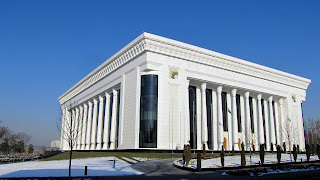


You can become a millionaire overnight in Uzbekistan, and be reduced to a pauper in no time too. I landed in Tashkent, the capital of this enchanting Central Asian country, on a snowy morning and headed straight to the money exchange to convert 500 dollars into Uzbekistani soms. In return, I was given a large bag of currency notes, which to my utter disbelief added up to over 15 lakh soms. I had suddenly become a millionaire in a strange land and my excited mind took flight on how to splurge this amount during my week-long holiday.

But my joy was short-lived. We went out for lunch hoping to savour some local delicacies, and I slumped in my chair when I saw the menu card. A prawn fry was priced at 18,000 soms, while a mutton grill was a princely 99,000 soms. A meal for two had set us back by about a lakh soms. The currency is so devalued that it’s not even worth the paper it is printed on. Thus, it is easy to become a millionaire in Uzbekistan, but there is not much you can buy with your millions.

A clean break
Once a prosperous link in the Great Silk Road connecting China to Europe, Uzbekistan became an independent country after the disintegration of the Soviet Union in August 1991. Though the country’s economy is not exactly in the pink of health, there is no visible sign of poverty. In fact, the opulence of Tashkent can put any modern city to shame. The capital is one of the most beautiful cities in the world with its immaculate tree-lined streets, wide walkways, large parks, historical monuments, imposing buildings, 8-D theatres, ballet shows, snow-capped mountains, excellent public transport system, pristine rivers and pollution-free environment. The man responsible for Tashkent’s transformation is Islam Karimov, the country’s president for 25 years, who died in late 2016.

Our tour began with a visit to the memorial of the then prime minister of India Lal Bahadur Shastri, who died in harness while in Tashkent. After paying our respects to the departed leader, we proceeded to the Memorial of Courage, which salutes the resilience of the people of Tashkent after it was flattened by an earthquake in 1966. The memorial, which comprises a gigantic statue of a couple with a child clinging on to the mother, was erected on the 10th anniversary of the earthquake.

Though Tashkent is known for its numerous mausoleums and madrasas, the Hazrati Imom Jome Masjidi, one of the most important Islamic centres in Uzbekistan for more than a 1,000 years, stands apart for its architectural splendour. The complex is built near the grave of one of the earliest imams of Tashkent, Abu Bakr Muhammad Kaffal, a poet, craftsman and expert in Islamic studies. All monuments and minarets have exquisite mosaic work, which is why Uzbekistan is called the country where mosaic rises to the sky.
Not far from here is the Shahidlar Xotirasi, an awe-inspiring memorial for the fallen soldiers, with its high dome supported by pillars, well-manicured garden, and a placid, crystal-clear stream meandering through pine trees.

The crowning glory of Tashkent, however, is the Mustaqillik Maydoni or the Independence Square, a vast expanse of impeccably maintained lush green space overlooking the magnificent Parliament Building and several important monuments. Once you cross the silver entrance arch with figures of three intertwined storks perched atop, you face the main monument of the Independence Square, a golden globe on top of a pedestal. The monument represents the revival of Uzbekistan as a free independent state and its liberation from the erstwhile Soviet Union. The Independence Square is the social melting pot of the city.

No mention of Uzbekistan is complete without a reference to Amir Temur, the most respected leader of the country, whose influence extended from the Mediterranean to India during the 14th century. Temur’s multi-ethnic army was responsible for the death of over 17 million people during its exploits. The Amir Temur Square in the heart of Tashkent has a larger-than-life statue of this warrior astride a horse. Engraved below is his famous motto, ‘Power is in justice’.

For nature lovers
If you are a lover of nature, you might want to visit the botanical gardens, home to nearly 5,000 species of trees from across the world. You could also enjoy the scenic beauty at Charvi Reservoir, or try your hand at skiing at Chimgan Resort, called the Switzerland of Uzbekistan.

In case retail therapy tops your mind, there are many upmarket malls that can be reached through the underground Metro. But if you intend to savour a slice of Uzbekistan, a visit to the bustling centuries-old Chorsu Bazaar — located under a giant-sized turquoise dome — is a must.

If you are in a mood to shake a leg, Tashkent is known for its discos and night clubs where alcohol is freely available and liberally consumed. However, you are advised to make sufficient enquiries locally to ensure that you do not land at a place of ill-repute.

Old city calls
Once you have explored Tashkent, it’s time to discover Samarkand, perhaps the oldest inhabited city in Central Asia. One of the most-visited tourist spots in Samarkand is the mausoleum of Gur-I-Amir, which was restored by Amir Temur after it was destroyed by the Mongols. The world-famous Shakhi-Zinda, which includes over 20 buildings built between the 11th and 19th centuries, is a memorial to Kusam-ibn-Abbas, said to be a cousin of Prophet Mohammed. Local people believe that he continues to live in the ensemble to this day. The Ulugbek Madrasa, with its prominent bright-blue Greek-style domes, also merits a visit.

The Bibi-Khanym Mosque has an Indian connection. The mosque was built with the wealth looted from India during Amir Temur’s conquest in 1399. Nearly a 100 elephants and many artisans from India were employed in its construction.

Samarkand is also famous for its frontier food, kebabs — particularly shashlik — and local breads.

Uzbeks are fun-loving people, and you often encounter a boisterous crowd in restaurants that breaks into an impromptu dance after a meal.

While on the topic of food, the national dish of Uzbekistan is plov, which is very similar to the Indian pulau. Another popular fare on the menu is samsa, a not-so-distant cousin of samosa. Though chicken, mutton and beef are commonly served, it might help to be warned that some restaurants also offer horse meat.

Many restaurants also showcase the exotic belly dance, an epitome of grace and poise. In Uzbekistan, it’s considered a respected art form in which children are trained from an early age.

Uzbekistan has a bit of something for everybody — be it a historian, an art aficionado, a student of architecture, a nature lover, a foodie, a frolicker, a solo traveller, or a tourist. Whatever your interest, you are guaranteed to come back with a bag full of rich
experiences.

http://www.deccanherald.com/content/606526/hearty-welcome.html

Friday, February 24, 2017

Divine intervention on Shivaratri

M. Gautham Machaiah

Two days ago, my friend Ravi took me to a clairvoyant in Bengaluru, a Muslim lady with origins in Egypt. As I sat opposite her, she asked for my full name and appeared to go into a trance. Soon, she started muttering, “Shiva…Shiva...Shiva…”. I was a bit surprised she was taking the name of a Hindu God being a Muslim woman.

About thirty second later, she opened her eyes and asked me if I had recently visited a Shiva temple and I responded with an emphatic no. Seeming a bit confused, the lady said, “But in my vision, I can see you standing in front of a huge statue of Shiva. It is white in colour and at an elevated place.” I once again responded in the negative, and the clairvoyant shrugged, “Anyway that is what I see in my vision.”

At the Shiva-Parvati statue in Vizag
However, the next day when I was browsing through my Facebook page, I came across a photograph of Shiva and it struck me that lady was indeed right. It had completely slipped my mind that about a week ago, I had visited a hillock in Vizag, Andhra Pradesh, which had a huge white statue of Shiva and Parvati, just as she had described it!

While on the topic, the clairvoyant had also advised me to visit a temple which had a big statue of Shiva on Shivaratri day. The only such statue I could recall In Bengaluru was the one at Old Kemp Fort, but the thought of the huge rush there put me off and I reminded the lady that I was not a very religious person. She mildly admonished me and said, “You have to do it because that is what the vision says.”

While I was still contemplating if I should heed her words, a name instantly flashed in my mind—Pooja Singh, a good friend who had previously worked with the organisation that is in charge of the statue. I called her to check if there was a system of special darshan for an additional fee, something that is common in most temples today. Pooja who promised to revert with the details called me back a few minutes later. Yes, such a system did exist, but she said, “Gautham, you do not have to worry about anything. I have made all the arrangements.”

When I reached the temple early this morning, I was met by a very courteous executive by name Pam who escorted me inside and stationed me right before the gigantic statue of Shiva. It was a mesmerising scene. The view of dozens of arathis breaking the early morning darkness amid religious chants in the background was a sight to behold. It was like heaven had descended on earth.

Thanks to divine intervention, the entire process of my darshan took less than fifteen minutes, while otherwise I would have had to wait for over four hours.


As Paulo Coelho says, “When you want something, all the Universe helps you in achieving it.”

Wednesday, January 18, 2017

WORLD'S GREATEST ANTIDOTE


M Gautham Machaiah, Jan 15, 2017
Funny side up


Most of us are stressed because we take life more seriously than it should be. Many of us have even forgotten to smile, let alone laugh. Humour is an antidote to any problem or situation we face in life. It not only increases our happiness quotient, but also adds years to life


If you look around, you will notice that the people who live the longest are the ones with a strong sense of humour. Lord Dennings, the celebrated British judge who used humour in good measure all his life, even to send a strong message across, lived up to a 100 years. When a fellow judge delivered a verdict which went against popular sentiment, Lord Dennings did not make his displeasure felt directly. Instead, at a formal dinner where the judge was also present, Lord Dennings remarked, “Unlike my brother judge here, who is concerned with the law, I am concerned with justice.” The remark sent the audience into peals of laughter, but the message was loud and clear.

Khushwant Singh, in his book Khushwantnama, which he penned at the age of 98, a few months before his death, says, “I have never taken anything seriously, least of all myself. Humour is a leveller. It is also good for the soul. It keeps you healthy and is one of the keys to a longer life.”

Former Karnataka Chief Minister J H Patel liberally used humour as a communication tool to deflect criticism, extricate himself from a tricky situation, and settle scores with opponents without ruffling any feathers. When the Opposition accused the chief minister of receiving an expensive watch as a gift, Patel took the wind out of the sail by narrating a story: “A woman once asked Shankaracharya the difference between truth and untruth. Shankaracharya brought a pot of water and pointing to the moon, said: ‘That is truth.’ And then pointing to the reflection of the moon in the water, he explained: ‘That is untruth.’”

Similarly, said Patel, the Opposition could not distinguish between truth and untruth: “If you empty the water from the pot, will the moon disappear from the sky?”

Most of us allow our ego to take control of the situation, without realising that even a very tense moment can be diffused without losing one’s cool. The then Lok Sabha Speaker Balram Jakhar was inaugurating the World Humorist Conference in Hyderabad, when the microphone went dead. Instead of flaring up, Jakhar said with a smile, “I seem to have a bad day. The mic went off at the previous function too. When the mic-man was summoned, he naively remarked, ‘the speaker’s screw is loose’ and went on to repair the mic.” The microphone technician obviously did not understand the enormity of his unintended pun, but the humour was not lost on Jakhar, who continued with his speech.

Living a stress-free life also means the ability to laugh at ourselves. Once, YMN Murthy, a well-known humorist, was invited to deliver a lecture when some students who mistook him for renowned cartoonist R K Laxman, crowded around him for an autograph. Instead of taking offence, Murthy quipped, “I am not Laxman, but at my age I might look like one of his cartoon characters.”

If there is one single ingredient that can put our life on the right track and smoothen the creases of worry, it’s humour. Life is all about moments of laughter. These are the moments we will cherish forever. Once we make humour a part of our lives, the world will be a much better place to live in.

http://www.deccanherald.com/content/591486/worlds-greatest-antidote.html